
Menu
Carbon Removal at a Turning Point: From Climate Promise to Global Imperative
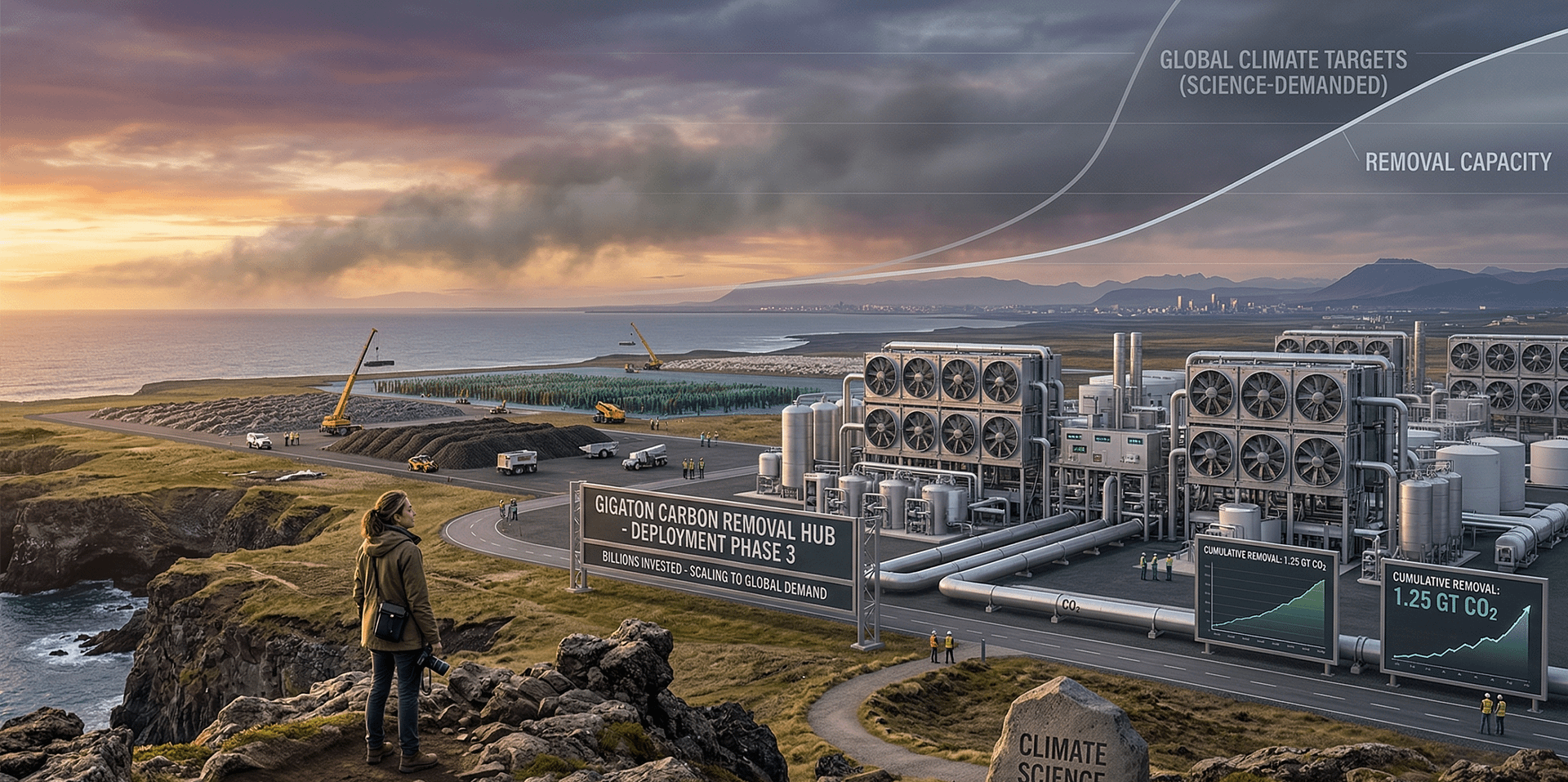
Carbon removal is rapidly shifting from theory to deployment, with billions invested and gigaton-scale targets emerging, yet the world remains far from what climate science demands.
The State of Carbon Removal Today
Carbon dioxide removal (CDR) has moved from the margins to the center of climate strategy. The Intergovernmental Panel on Climate Change states that limiting warming to 1.5°C will require removing 5–10 gigatons of CO₂ annually by 2050 (see report). Yet, current operational capacity remains below 0.01 gigatons per year, highlighting a massive scale gap.
Investment and Market Momentum
The voluntary carbon market and corporate commitments are accelerating growth. Over $2 billion has been committed to durable CDR purchases by companies like Microsoft and Stripe (https://cdr.fyi/). Governments are also stepping in; the United States alone has allocated $3.5 billion for Direct Air Capture hubs under the Bipartisan Infrastructure Law (Source: energy.gov).
Despite this momentum, most carbon credits still come from avoidance rather than removal, with less than 5% representing durable CDR solutions (source: IEA).
Carbon removal (MtCO₂/yr)
Levels of novel CDR in 2023 (Source: The State of Carbon Dioxide Removal 2nd Edition)
Technology Landscape and Scale Potential
CDR pathways vary widely in maturity and scalability. Nature-based solutions like afforestation are already deployed but face permanence challenges. Engineered approaches such as Direct Air Capture (DAC) and bioenergy with carbon capture offer higher durability but remain costly.
Enhanced Rock Weathering (ERW), a focus area for companies like Eartures, presents a hybrid pathway. Studies suggest ERW alone could remove 2–4 gigatons of CO₂ annually if deployed on global croplands (Source: nature).
The Bottlenecks
The primary constraints are cost, verification, and infrastructure. Durable CDR technologies currently range from $100 to $600 per ton of CO₂, far above the levels needed for mass adoption (Source: IEA). Measurement, Reporting, and Verification (MRV) systems are still evolving, especially for distributed approaches like ERW.
The Road Ahead
The next decade will define whether carbon removal scales in time. Bridging the gap will require policy support, standardized MRV frameworks, and integration with industrial and agricultural systems. Without rapid expansion, global climate targets will remain out of reach.
References
IPCC AR6 Working Group III Report: https://www.ipcc.ch/report/ar6/wg3/
CDR.fyi Market Data: https://cdr.fyi/
International Energy Agency (IEA) CCUS and CDR Reports: https://www.iea.org/
U.S. Department of Energy – DAC Hubs: https://www.energy.gov/
Beerling et al. (2020), Nature – Enhanced Rock Weathering: https://www.nature.com/articles/s41586-020-2448-9
Smith, S. M., Geden, O., Gidden, M. J., Lamb, W. F., Nemet, G. F., Minx, J. C., Buck, H., Burke, J., Cox, E., Edwards, M. R., Fuss, S., Johnstone, I., Müller-Hansen, F., Pongratz, J., Probst, B. S., Roe, S., Schenuit, F., Schulte, I., Vaughan, N. E. (eds.) The State of Carbon Dioxide Removal 2024 – 2nd Edition. DOI 10.17605/OSF.IO/F85QJ (2024)


- 2026 Eartures. All Rights Reserved.
- Privacy Poilicy