Enhanced Rock Weathering (ERW): A Scalable Pathway for Carbon Removal and Soil Regeneration

As global temperatures continue to rise, the urgency to deploy large-scale carbon dioxide removal (CDR) technologies has intensified. Among emerging solutions, Enhanced Rock Weathering (ERW) stands out as a scientifically grounded, scalable, and co-beneficial approach that not only captures atmospheric CO₂ but also improves soil health.
At Eartures, our research focuses on integrating geospatial intelligence, mineral analytics, and field-scale validation to evaluate the real-world potential of ERW across diverse terrains. This article presents a research-driven perspective on ERW, supported by data, field insights, and global studies.
Understanding Enhanced Rock Weathering
Enhanced Rock Weathering accelerates a natural geological process in which silicate minerals react with atmospheric CO₂ and water, forming stable bicarbonates that are eventually transported to oceans or precipitated as carbonates.
The simplified reaction involves minerals such as olivine or basalt reacting with CO₂ to form dissolved bicarbonate ions, effectively locking carbon away on geological timescales. Under natural conditions, this process occurs over thousands to millions of years, but when finely ground silicate rocks are applied to soils, the reaction rate increases dramatically due to higher surface area and soil biological activity.
Field and laboratory studies indicate that finely crushed basalt can remove approximately 0.3 to 1 ton of CO₂ per ton of rock applied, depending on mineral composition, grain size, and climatic conditions.
Global Potential and Scale
Recent assessments suggest that ERW could play a significant role in global carbon removal strategies. A landmark study published in Nature estimates that widespread deployment of ERW on agricultural lands could remove between 2 to 4 gigatons of CO₂ annually by 2050, particularly in tropical and subtropical regions where weathering rates are highest.
Another analysis by the Intergovernmental Panel on Climate Change (IPCC) identifies ERW as a promising negative emissions technology with relatively low technological barriers compared to direct air capture systems.
India, with its vast agricultural base of over 160 million hectares, presents a uniquely favorable environment for ERW deployment. Basaltic provinces such as the Deccan Traps provide abundant feedstock, reducing transportation emissions and costs.
Field Evidence and Measured Outcomes
Field trials conducted across the United States, the United Kingdom, and Australia have demonstrated measurable carbon removal and soil benefits. In controlled experiments, basalt application has shown CO₂ sequestration rates ranging from 0.5 to 2 tons per hectare per year, depending on rainfall and soil chemistry.
Research led by the University of Sheffield and the Leverhulme Centre for Climate Change Mitigation observed that ERW not only captures carbon but also enhances soil pH, nutrient availability, and crop yields. In tropical trials, yield increases of up to 15–20% have been reported due to improved soil fertility.
At Eartures, our internal assessments align with these findings. By integrating remote sensing data with geochemical modeling, we have identified high-potential ERW zones where climatic conditions, soil properties, and mineral availability converge to maximize weathering efficiency.
Mineral Selection and Geochemical Considerations
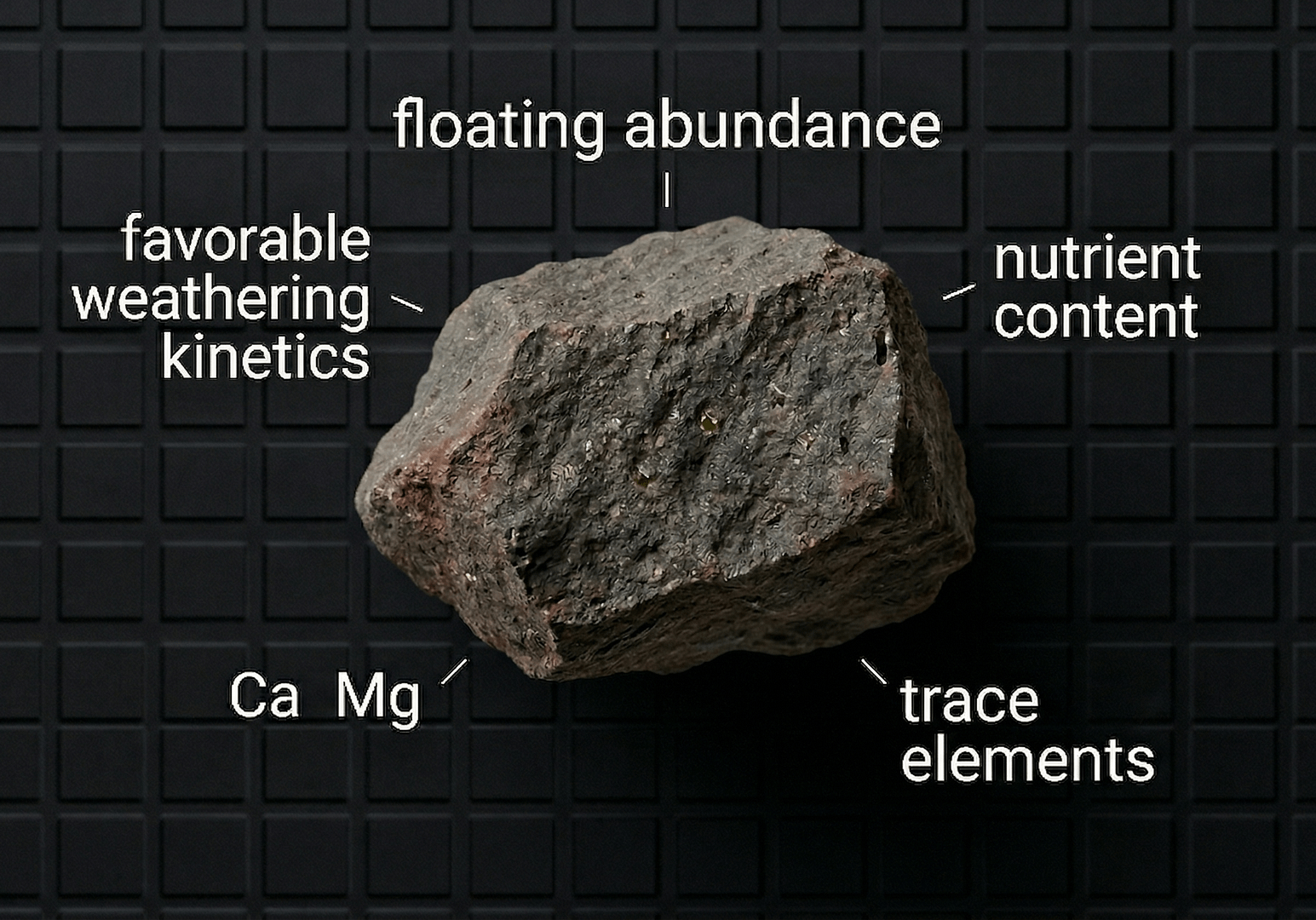
Not all rocks are equally effective for ERW. Basalt is widely preferred due to its abundance, favorable weathering kinetics, and nutrient content, including calcium, magnesium, and trace elements beneficial for plant growth.
Ultramafic rocks such as peridotite offer even higher CO₂ sequestration potential due to elevated magnesium content, but their limited availability and potential heavy metal content require careful assessment.
Our mineralogical analysis emphasizes the importance of grain size distribution, reactive surface area, and trace element composition. Finely ground material increases reaction rates but also raises energy requirements for comminution, creating a trade-off that must be optimized.
Monitoring, Reporting, and Verification (MRV)
A critical challenge in ERW deployment is the accurate measurement of carbon removal. Unlike point-source capture technologies, ERW operates over large, distributed landscapes, making Monitoring, Reporting, and Verification (MRV) complex.
At Eartures, we address this challenge by combining:
Geospatial datasets from satellite platforms
On-ground soil and water chemistry measurements
AI-driven predictive models for weathering rates
This integrated approach allows us to estimate carbon fluxes with higher confidence and scalability. Emerging techniques, such as tracking dissolved inorganic carbon in runoff and isotopic analysis, are further improving MRV accuracy.
Economic and Operational Feasibility
The cost of ERW is currently estimated between $80 to $200 per ton of CO₂ removed, depending on logistics, grinding energy, and application methods. However, when co-benefits such as improved crop productivity and soil health are considered, the effective cost can be significantly lower.
India’s proximity to basalt sources and large agricultural workforce creates an opportunity to reduce costs further, potentially making ERW one of the most economically viable CDR solutions in the region.
Environmental and Social Considerations
While ERW offers significant promise, it must be deployed responsibly. Potential risks include dust generation during application, changes in soil chemistry, and trace metal mobilization. However, existing studies indicate that when properly managed, these risks are minimal and can be mitigated through standardized protocols.
Importantly, ERW aligns well with sustainable agriculture practices, offering farmers both climate incentives and productivity gains.
The Eartures Approach
At Eartures, we are advancing ERW through a combination of data-driven targeting, mineral characterization, and field validation. Our work focuses on identifying optimal deployment zones, optimizing material selection, and building scalable MRV frameworks.
By leveraging our expertise in geospatial intelligence and mineral systems, we aim to transform ERW from a promising concept into a deployable, measurable, and economically viable climate solution.
Conclusion
Enhanced Rock Weathering represents a convergence of geology, agriculture, and climate science. Its ability to deliver permanent carbon removal alongside tangible agricultural benefits makes it a compelling solution for the decades ahead.
As the world seeks scalable pathways to achieve net-zero targets, ERW offers a unique advantage: it works with natural processes, amplifying them through science and technology.
The challenge now lies not in proving its potential, but in deploying it at scale with precision, accountability, and impact.
References
Beerling, D.J. et al. (2020). Potential for large-scale CO₂ removal via enhanced rock weathering with croplands. Nature. https://www.nature.com/articles/s41586-020-2448-9
IPCC (2022). Climate Change 2022: Mitigation of Climate Change. https://www.ipcc.ch/report/ar6/wg3/
Kelland, M.E. et al. (2020). Increased yield and CO₂ sequestration potential with ERW. Global Change Biology.
Taylor, L.L. et al. (2016). Enhanced weathering strategies for stabilizing climate. Nature Climate Change.
Amann, T. et al. (2020). Enhanced weathering and its role in carbon removal. Biogeosciences.
- 2026 Eartures. All Rights Reserved.
- Privacy Poilicy